From Safety Net to Springboard: Reframing Human Services

How we talk about human services shapes how we value them. Join HealthSpark Foundation on Friday, October 30 for a Community of Practice event rooted in possibility. We're coming together to explore how the stories we tell shape public understanding, policy, and investment -- and how, together, we can tell a better one.
This gathering will connect the work of human services to economic mobility, wealth gaps, and thriving communities, inviting all of us to see this work not simply as a response to crisis, but as one of the most hopeful investments we can make -- in people, in each other, and in our shared future. Through honest conversation and shared learning, we'll explore the power of language, messaging, and storytelling to drive meaningful change, and draw inspiration from the work of building and rooting power within communities.
Because human services aren't just a safety net that catches people -- they're a springboard that helps us all rise, together.
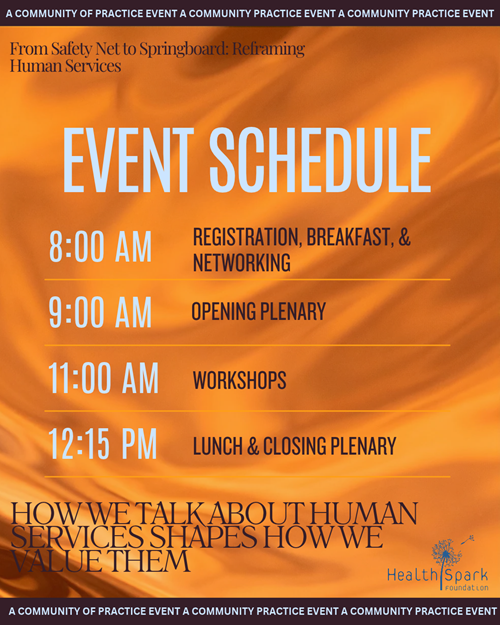
Registration, breakfast, & networking begins at 8 AM, with our main program from 9 AM to 1 PM. Come ready to connect, learn, and imagine what becomes possible when we change the story -- and recognize human services for what they truly are: an investment in the strength, stability, and shared prosperity of our communities.
Event Schedule
Keynote: Amanda Misiko Andere, Co-President of Neighborhood Funders Group
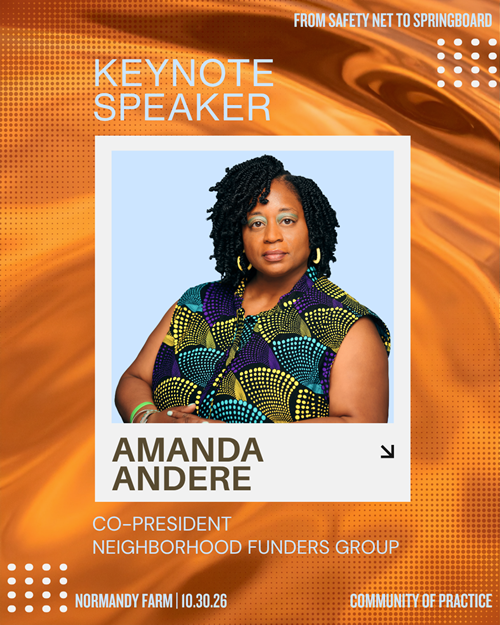
This year's opening plenary asks us to sit with the questions many of us carry but rarely have space to explore together: What does liberation actually look like for our communities? Are the systems we've built truly working, or are we managing symptoms while root causes go unaddressed? And are we honoring the work happening every day on the ground, often without recognition, often stretched thin, but never without purpose?
From her vantage point in aligning movement-building organizations nationally, Amanda Andere will guide us through these questions -- not with easy answers, but with the kind of honest reflection this sector needs if we're serious about lasting change. We'll look at where the field has been, where it's headed, and what it will genuinely take to move from good intentions to real transformation. This is a conversation about liberation as a practice, not just a goal -- and about what we owe the people doing this work every day.
Amanda has spent over twenty years working in the nonprofit and public sectors as a leader committed to racial and housing justice through advocacy for systemic change. She is Co-President, Political Home of Neighborhood Funders Group, a network of funders that mobilizes philanthropy to resource organizing and movements so that Black, Indigenous, and people of color communities and low-income communities thrive. She most recently served as the CEO of Funders Together for Housing Justice for ten years. Previously, she has served as the CEO of Wider Opportunities for Women, a national advocacy organization, and FACETS, a direct service organization in Northern Virginia. She currently serves on the boards of Equity in the Center, Bainum Family Foundation, and Leadership Fairfax, and is an appointed member of the Fairfax County racial equity roundtable.
Past leadership roles include serving as Chair of the United Philanthropy Forum's board and as a board member of Philanthropy DMV. Amanda is a founding member of the National Racial Equity Working Group on Homelessness and Housing and the National Coalition for Housing Justice.
Fireside Chat
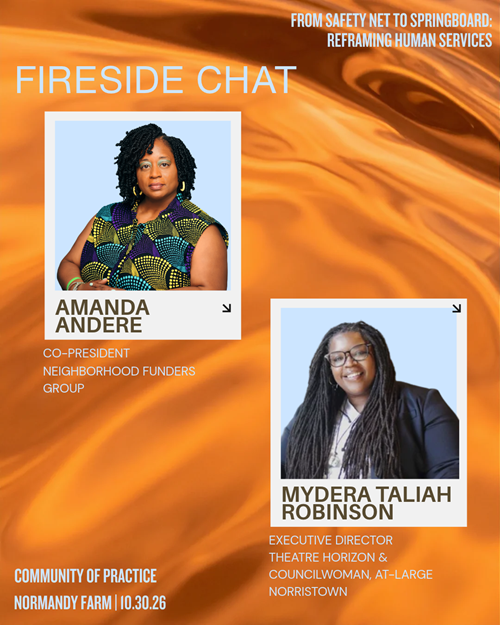
What does liberation look like when it comes home? Following her opening plenary, Amanda continues the conversation alongside Mydera Taliah Robinson, Executive Director of Theatre Horizon and Councilwoman At-Large for Norristown. Amanda brings the national view from her work aligning movement-building organizations; Mydera brings the view from a community where she leads both an arts institution and a seat in local government. Together they’ll explore where big ideas meet everyday reality: what it takes to address root causes at the local level, how a community’s stories shape the decisions made about it, and what honoring the people doing this work looks like in practice. This is a chance to dive deeper into the keynote’s points, and to bring your own questions into the room.
Workshops - Spaces for Learning
This year, we’re thrilled to offer workshops -- less presentation, more discussion, with a purpose to help us move from ideation to action on the horizon. Registrants will receive an invite to pre-select the workshop of their choice.
Each workshop will explore a theme central to the work needed to shift the way we talk about human services and how we value them. Field experts will facilitate each one with workshop components that feature their expert opinions, real-life examples of the work they are seeing and creating in their respective fields, guided group activities, and more.
Board Development: Seeing the Vision, Sharing the Work
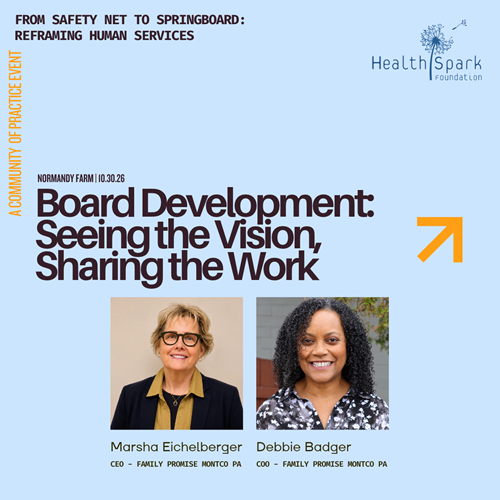
This workshop will explore what it looks like to build boards that are curious about the work, willing to learn, and ready to use their leadership to help make that vision possible.
Strong organizations need strong boards. It’s not only about approving budgets or responding to what is in front of them. It’s also about seeing a vision, where an organization is trying to go, and understand their role in helping that organization to get there. In the human services sector, this is especially important: everyday, organizations are navigating growing needs, changing systems, policy challenges, and more.
Marsha has dedicated more than 20 years to advocating for families experiencing housing and food insecurity. As CEO of Family Promise Montco PA since 2013, she has transformed the organization through innovative programming, strategic partnerships, and a deep commitment to equity and dignity. Her greatest strength is bringing people and organizations together to create meaningful, lasting change. Under her leadership, Family Promise has significantly expanded its housing and food programs, strengthened community partnerships, and increased its impact across Montgomery County. Marsha’s leadership has been recognized through numerous honors, including the 2023 Justice and Peace Award for her anti-racism work.
Debbie is Chief Operations Officer of Family Promise Montco, where she leads organizational strategy, operations, technology, and post-merger integration efforts. With more than 25 years of leadership experience spanning the nonprofit and corporate sectors, she has a proven track record of driving organizational growth, strengthening community partnerships, and leveraging technology to improve efficiency and mission impact. Before joining Family Promise Montco, Debbie held global leadership roles at IBM. She is passionate about building strong organizations, fostering collaboration, and advancing solutions that help families achieve housing stability and long-term success.
Harnessing Resources: People, Power, & Money
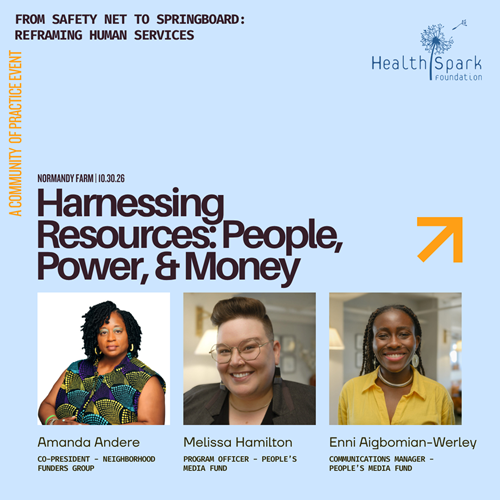
Every community already holds the resources it needs to shape its future: dollars, relationships, time, lived experience, and the stories people tell about where they live and what they deserve. This workshop explores how those resources get organized, and who decides where they go.
We’ll look at how power is built in practice through relationships, leadership development, and sustained organizing, and talk plainly about philanthropy’s role: grant dollars matter most when they seed the work that builds lasting capacity, like community organizing, movement infrastructure, and efforts to change the public narrative around housing, health, and economic opportunity. Join Amanda, Melissa, and Enni for a discussion considering what it takes to build community power, where funders are most useful (and where they should step back), how the stories we tell shape what seems possible, and how organizers, nonprofits, funders, and residents can work from a shared strategy rather than in parallel.
Melissa's bio coming soon.
Enni leads communications at People's Media Fund, where she supports storytelling about community-led media organizations and projects that are building narrative power for equity and justice in the Greater Philadelphia region. As a strategic storyteller and visual content creator, Enni continuously explores new and creative ways to use communications to drive social change.
Shaping Public Understanding
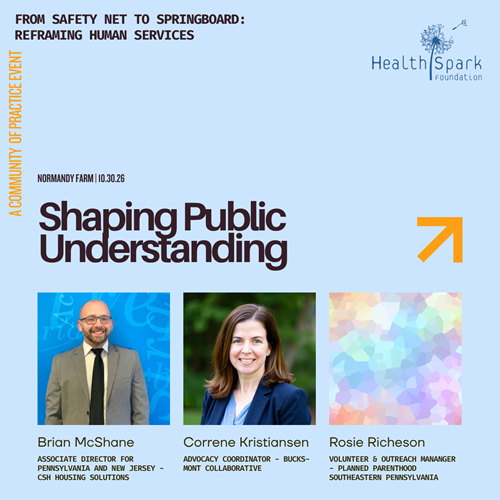
This workshop will bring light to the types of language, messages, and stories we can use to shape public understanding of human services.
Sometimes changing the world begins with changing the way we see it. For so long, human services have been described through the moments when people need help: a crisis, a hardship, a gap that needs to be filled. But there are other stories we could tell: about possibility, belonging, opportunity, and the remarkable things people and communities are already building.
Brian is the Associate Director for PA & NJ at the Corporation for Supportive Housing (CSH), where he advances strategies that expand access to supportive housing and strengthen systems serving people experiencing homelessness, housing instability, and complex health and behavioral health challenges. With expertise in housing policy, program development, cross-sector partnerships, and systems change, Brian works with government agencies, providers, healthcare organizations, and community stakeholders to design and implement sustainable housing solutions. He is committed to advancing approaches that improve outcomes for vulnerable populations and has experience translating policy and research into practical, community-centered initiatives that drive lasting impact.
Correne is the Advocacy Coordinator at the Bucks-Mont Collaborative, where she works to advance policy priorities in behavioral health and housing for Bucks and Montgomery Counties. She brings 10 years of experience in policy and politics, most recently as Chief of Staff to PA Senator Maria Collett. A Bucks County native, Correne holds a BA from Johns Hopkins University, a JD from NYU School of Law, and spent nearly a decade writing and working in television production in Los Angeles.
Rosie's bio coming soon.
We Are the Common Good Sector
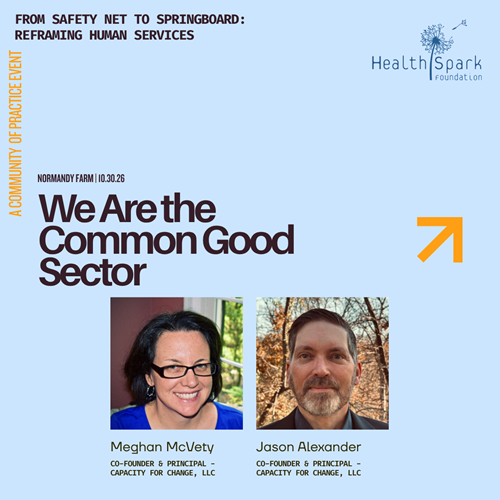
This workshop will engage participants in the idea of changing what our sector is known as, because if we do, we will be able to shine a clearer, brighter light on what is possible when people come together for the common good.
nonprofit (noun): an organization whose most important goal is something that does not involve making a profit; (adjective): not conducted or maintained for the purpose of making a profit
Our sector’s goal is to make things better. Our goal is not ‘to not make a profit.’ Of course, because that’s absurd. And yet, nonprofit is the most commonly used word to describe the type of organizations in our sector, a misnomer that creates confusion and condescension, gives permission to underpay people and to under-resource organizations, and diminishes all the goodness involved in who we are and what we do, buoyed by good people all around us. Our sector has long been defined by what we are not, rather than by what we are: heart and goodness; pillars and fabric of communities and ideas; protectors and advocates; economic engines; caregivers; barrier breakers; sources of inspiration, connection, and opportunity.
We work for the common good, for what benefits society as a whole, which happens when people are deeply connected within their communities – that is who we are as a sector. We are the common good sector. Imagining a better future for everyone begins with lifting up our common goodness.
Meghan's bio coming soon.
Jason's bio coming soon.
Where We Live, How We Thrive
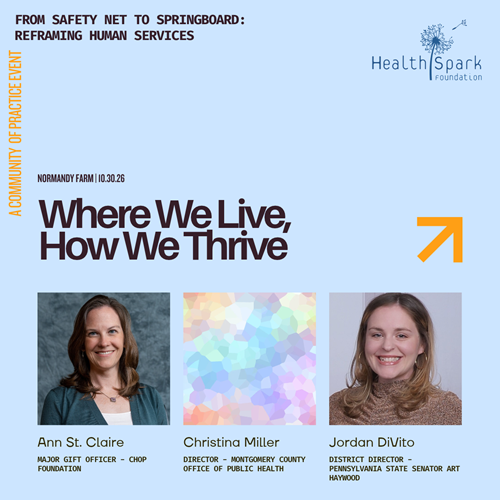
Inspired by the Social Determinant of Health - Neighborhood and Built Environment, this workshop will help us wonder what the places people are born, live, learn, work, play, worship, and age in should look like.
There is so much more about our health outside of annual check-ups and doctors appointments. It begins at home. In our neighborhood. At school. At work. And in the places we gather or where we don’t have places to gather. Can we breathe clean air? Find healthy food? Have access to transportation? Feel safe walking down the street? Are we in community?
Once we look at the whole picture of health, possibilities appear. A community can become a part of a health strategy. A human services organization can be part of the infrastructure that helps people thrive. We’ll explore how health equity connects to the neighborhood and social conditions that shape health, opportunity, and wellbeing.
Ann is a public health professional with over 20 years of experience addressing the harms of tobacco use through research, evaluation and grant-making. She has also served on a number of boards of directors for non-profit organizations aiming to improve the health and well-being of community members, and women and children in particular, in the greater Philadelphia region. Currently, Ann is a fundraiser for the Children’s Hospital of Philadelphia Foundation. She believes in the power of collaboration, philanthropy and community action to create healthy, equitable communities for everyone to live, grow and learn.
Christina's bio coming soon.
Jordan serves as District Director for Pennsylvania State Senator Art Haywood, where she leads community partnerships, addresses constituent needs, and advances the outreach mission of the 4th Senate District. She has worked in Pennsylvania state government for nearly a decade, beginning her public service in 2017. Prior to her government career, Jordan worked in the nonprofit sector supporting individuals experiencing chronic mental illness, substance use challenges, homelessness, and recovery from natural disasters.
Jordan cares about mental health advocacy, expanding access to affordable and accessible housing, strengthening civic education, and fostering community resilience and connectedness.